

Introduction
We had a very active third quarter. A few high-level notes before we dive in:
- Clean Growth III-VI benefited from multiple liquidity events and positive portfolio developments—see Impact Secondaries section below.
- The Sustainable Infra team invested in OBE Power to support the expansion of OBE’s EV charging network across the USA and Canada (more below). The infra team continues to see attractive investment opportunities across battery energy storage, solar and EV charging and has co-investments available. If you would like to learn more, please contact Adam Bernstein.
- Reminder, if you need liquidity and have an impact investment to sell, please contact Brad Fox on our secondaries team.
Electricity Generation vs. Demand. The Western world and China are in a race for artificial intelligence/super intelligence (AI) dominance. That means a race to produce not only the top performing large language models (LLMs) but also the means to build the computing capability and the energy and other infrastructure necessary to win (collectively, the “compute”). In the West that means the AI platforms (Anthropic, OpenAI, SpaceX, etc.) and Hyperscalers (Google, Amazon, Microsoft, etc.) need to work together with (a) chip companies for CPUs, GPUs, memory and the networking interfaces among them, (b) power producers including on-site power, regional utilities and independent power producers, (c) grid infrastructure/transmission companies, (d) power equipment makers and (d) fuel suppliers. Shift Lab provides a helpful/illustrative chart of the AI tech stack here.
Each side is racing to be first and there are abundant impact investing opportunities throughout that stack, which is why we keep writing about it.
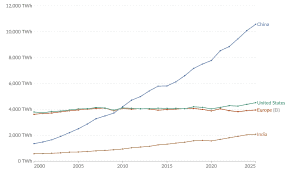
The chart below from Our World in Data, shows China is very capable of building new electricity generation, while the West has largely stayed steady for several decades.
Electricity Generation 2000 to 2025
Measured in terawatt-hours
Can the West catchup and build enough electricity generation capability to win? Will all that power be built on Earth or are we going to need to build orbital data centers that harness the Sun’s energy 24/7? It is going to be interesting.
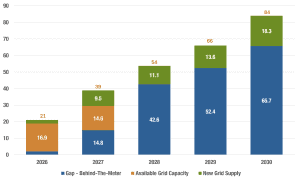
Here in the USA, it is estimated that we are going to build 21 GWs of new compute in 2026, followed by 39 GWs in 2027 and 54 GWs in 2028. Some of that will be powered by existing grid capacity but next year 38% of the new compute will be powered behind the meter—built onsite at the data center using solar, gas turbines, diesel generators, geothermal, nuclear and energy storage from batteries and thermal systems. In 2028, behind the meter is expected to dominate, contributing 79% of the overall addition. Again, there is a tremendous opportunity for impact investors to invest in these megatrends.
US Datacenter Capacity Net Additions by Power Source (Gross DC MW)
Behind-The-Meter towards 50GW+ by 2028
Source: SemiAnalysis Energy Model
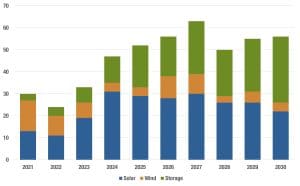
Even within the US grid, there are clear opportunities for impact investors. Solar, wind and energy storage are expected to contribute 50+ GWs per year from 2026-2030.
US Grid Nameplate Capacity (Additions) — By Fuel (GW)
Source: SemiAnalysis Energy Model
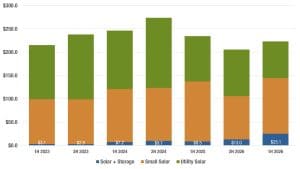
Sun and Batteries. Solar + storage is coming on strong as the need for electricity rises for data centers, reshoring of manufacturing and EVs. Solar + Storage can be quickly permitted, constructed and energized—faster than gas turbines, for example. So, it is becoming an essential part of new construction worldwide—see blue sections of the chart below. In the first half of 2026, $25.1 billion of Solar + Storage was installed, which was nearly double the $13.0 billion installed during the second half of 2025.
Global Solar Installations ($B)
Source: BloombergNEF and Canary Media
In Q2 2026, the US added 20.2 GWh of battery capacity, which was a record. According to the Solar Energy Industries Association (SEIA), US battery energy storage capacity nearly doubled in the first 18 months of the second Trump administration, increasing from 88 GWh to 165 GWh. The new installations came mainly from grid operators utilizing storage for grid stabilization (18 GWh). However, industrial players (manufacturers and data centers) and homeowners also played a role, adding 1.8 GWh and 0.7 GWh, respectively, during the quarter. Per SEIA and Benchmark Mineral Intelligence, Texas and California led the way, installing 3.8 GWh and 3.6 GWh, respectively in Q2. Arizona, Nevada, Oregon, Colorado and other states also showed large installations. The US is now the second largest battery manufacturer in the world (behind China), thanks in part to new battery cell manufacturing facilities coming online in Ohio and Tennessee and a new 50 GWh battery module facility coming online in Texas. Meaning there are significant jobs creation and onshoring elements to this trend as well.
Climatech Fundraising Declines. Climatech VC fundraising has declined in recent years, from a peak of $10.5 billion raised by 85 funds in 2021 to just $3.9 billion raised by 37 funds in 2025. 2026 is on pace for further declines with only $546 million raised across six funds through mid-August. Per Pitchbook, the biggest funds raised this year hail from Denmark and the UK, indicating Europe is “picking up the slack while US policy headwinds weigh on domestic climate specialist managers.”
Climate Tech VC Fundraising Activity
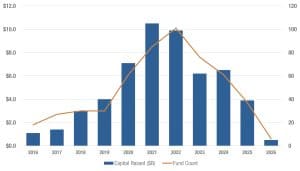
Source: Pitchbook. Data is global and as of August 18, 2026
The Robots are Coming. Many venture capitalists believe robots are going to become ubiquitous over the next 5-10 years, most notably humanoid robots. Companies like NEO, Unitree Robotics, Figure AI, Tesla, Boston Dynamics and Agility Robotics all have humanoid robots on the way. Humanoid robots will wash your dishes and fold your clothes; others will mow your lawn or pick up after your dog. Industrial robots, already a fixture in auto manufacturing plants and warehouse distribution centers, will next push into mining, agriculture and specialized tasks like solar farm construction, underwater welding/repair and orbital satellite maintenance.
VC Deal Activity: Robotics & Physical AI
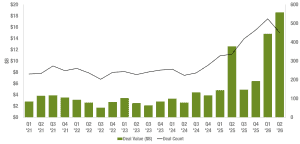
Source: Pitchbook
We believe self-driving cars will become the norm with surprising speed due to safety and convenience factors. Data from Waymo and Tesla suggest self-driving cars are 1.5-9x safer than human driven cars and that gap ought to continue to widen as self-driving tech continues to evolve. China has self-driving taxis in about twenty cities today. Fifteen US cities are currently served by self-driving taxis from one or more combinations of Waymo (Alphabet/Google), Zoox (Amazon) and Tesla. The Netherlands approved full self-driving cars in April and Croatia, the UK, Germany, Spain, Luxembourg, Switzerland and others are undergoing trials of self-driving cars and/or taxis. The age of automation is upon us.

Market Update
Update on Latest Clean Growth Funds. CG VI made its final investment in Q3. We are pleased with the final construction of the portfolio and the diversification that has been achieved across investment structure, geography, company stage and impact theme. For investments made during Q1 2026 or earlier, 15 of those 22 investments have made at least one distribution back to the fund. As such, the fund is quickly transitioning into its harvesting phase (0.21x DPI), and we anticipate the fund’s next distribution will occur prior to yearend.
As noted above, CG VII has been activated and has closed two investments so far, with several more expected to close in Q4. We are seeing terrific deal flow, much of which is tied to the tremendous amount of capital that was raised by climatech funds from 2018-2022 (see fundraising chart in the Introduction). Those vintages are now in our sweet spot for secondary activity—mature enough where both LPs and GPs can see the early winners in the portfolio (leading to continuation vehicle opportunities) and also begin to make predictions about the ultimate outcome of those funds (leading to traditional LP secondary sales, as well as GP-led preferred equity/structured transactions to support the portfolio). Overall, we are seeing roughly 2x the number of deals as we did just 12-18 months ago. We attribute that to a “flywheel” effect where we are benefitting from past activities. Examples include (a) a handful of seasoned venture capital teams are actively seeking (on our behalf) impact portfolios that can be acquired from corporate VCs or “zombie” managers and re-energized, (b) investment banks/brokers have a list of funds we are seeking to buy and are actively working to broker transactions from that list and (c) our relationships with an ever-expanding group of investment banks serving the continuation vehicle marketplace, all of which is producing more opportunities than ever before. We are also seeing strong opportunities for preferred/structured investments, with strong risk protections, from a core group of climatech VCs. Finally, it is worth noting that we are seeing many traditional LP secondary opportunities in recent vintage funds but are passing over them as most of them are still in the early venture/risky stage. We strongly prefer more mature and growth-oriented LP-led deals.
Exit Activity and Notable Portfolio Company Events
Clean Growth III:
- XPV sold its interest in BCR, a provider of sustainable biosolids and waste treatment solutions, to a confidential syndicate of investors in July, resulting in a distribution in late September to CG III, IV & V.
Clean Growth IV:
- General Fusion (NASDAQ: GFUZ), went public in July through a SPAC transaction that raised $150 million, becoming the first fusion company to trade publicly. The company is backed, in part, by Jeff Bezos. It is held in both CG IV and CG V.
- See CG III for BCR.
Clean Growth V:
- Intellihot, a manufacturer of commercial tankless water heating systems, was acquired by Zurn Elkay Water Solutions (NYSE: ZWS) for $108.5 million in July.
- Crusoe raised $3.9 billion at a $30.9 billion post-money valuation in September. It is held in both CG V and CG VI WSJ | Crusoe Raises $3.9B Series F at a $30.9B Valuation for AI Infrastructure.
- We can now confirm the IPO of Neutron Holdings(Lime electric scooters). As our prior market commentary went to print, this IPO was pending. The company (Ticker: LIME) priced at $25 a share, raising $167 million and valuing the company at about $1.66 billion. It is held in both CG V and VI.
- In September, Locus Robotics, a developer of autonomous industrial mobile robots and software, raised $41.6 million as part of their Series G round, valuing the company close to $2 billion. It is held in both CG V and CG VI. Locus Robotics Raises $41.6 Million in Series G Funding.
- In July, Schneider Electric announced plans to acquire AiDASH, an AI-powered risk intelligence provider, valuing the company at $350 million. It is held in both CG V and CG VI. Schneider Electric to Acquire Grid Resilience Solutions Provider AiDASH for $350 Million.
- See CG III for BCR.
- See CG IV for General Fusion.
Clean Growth VI:
- In June, Elroy Air, a Byron, Calif.-based cargo drone startup, agreed to go public via a reverse merger with Columbus Circle Capital Corp. II (Ticker: CMII) at an $800 million pre-money valuation. Elroy has raised over $100 million from firms like Shield Capital, Lockheed Martin Ventures, Marlinspike and Catapult Ventures.
- The Amlon Group, a provider of sustainability-focused industrial waste management solutions, continues to distribute operating profits, highlighting demand for tailored waste remediation services.
- In July, Blackstone Energy Transition Partners announced plans to acquire Dresser Utility Solutions, a manufacturer of meters, pressure-control devices and repair products that gas and water utilities use to measure, regulate and fix their pipe networks
- Trillium Flow Technologies, a manufacturer of highly engineered valves, pumps and actuators for critical power, water and chemical infrastructure sold its French valves business to Framatome in June.
- A Reach Capital portfolio company that specializes in AI text detection and content authenticity, GPTZero, entered a definitive agreement to be sold to Superhuman (FKA Grammarly) in June. GPTZero plans to join Superhuman.
- Motive Technologies, an SF-based provider of fleet management solutions, raised $1.3 billion in September from General Catalyst and subsequently withdrew its IPO registration due to being sufficiently capitalized for their go-to-market strategy. The company has raised over $770 million from firms like GV, Index Ventures, Kleiner Perkins, IVP, Greenoaks, Base10 Partners and Scale Venture Partners.
- In August, Risepoint, a higher education technology and services company that helps universities expand access to affordable, workforce-relevant online education, announced their acquisition of the North American operations of Keypath Education. Risepoint Acquires Keypath Education’s North American Operations to Expand Online Healthcare Education and Clinical Placement Services.
- See CG V for commentary on Crusoe, Neutron Holdings (Lime), Locus Robotics & AiDash.
Other portfolio news in CG VI:
- In August, Muon Space, a low Earth orbit satellite manufacturer, raised $250 million in Series C funding led by Eclipse Capital, joined by Institutional giants like Google and Salesforce in tandem with many venture capital firms.
- Earlier this year, we participated in Alder’s multi-asset continuation vehicle inclusive of Sustainable Intelligence, a Swedish provider of energy-efficiency and sustainability solutions, and Safe Monitoring Group, a Swedish provider of environmental monitoring and compliance services.
Clean Growth VII:
- In partnership with Uniper, Carbon Clean was awarded an engineering contract to provide carbon capture engineering to process biogenic CO2 feedstock to advance Uniper’s NorthStarH2 e-methanol project in Sweden. The planned facility will utilize renewable electricity and biogenic carbon dioxide as part of their synthetic, clean e-methanol production. Uniper Enters Basic Engineering Phase For Swedish NorthStarH2 Facility.
- North Sky participated in Verdane’s multi-asset continuation vehicle earlier this year. The portfolio includes Arrive, which is a roll-up of EasyPark, ParkMobile and Flowbird to help streamline digital parking and traffic management, reducing cars’ environmental impact.
Secondary Market Commentary. The secondary market continues to evolve and mature, including our niche within the impact sector. All investors are affected by (a) the AI boom, (b) the surge in demand for electricity to power data centers, manufacturing and EVs, (c) the reshoring of jobs, (d) the conflicts in Ukraine and Iran, (e) $6/gallon diesel prices and other macro and geopolitical factors. Some of those negative factors may be dampening the liquidity outlook. Early reads on Q3 M&A activity show a material dip from a strong Q2, and the IPO window does not appear to have opened further despite what we would deem a successful IPO of SpaceX where the company continues to trade above its IPO price even after the first series of lock-up expirations. More recently, the 10-year US treasury yield has surpassed 5%, a level not seen since 2023, and before that 2007. The Fed responded by raising rates at its September meeting, which raises borrowing costs across the economy and pressures valuation multiples for businesses looking to sell or raise capital to fund their next phase of growth.
Even so, the underlying picture is more constructive than the headlines suggest. Equity markets sit at or near all-time highs, and the Q2 earnings cycle showed incredible strength. Q2 earnings increased 50% year-over-year and even when excluding AI companies, earnings growth was a healthy 32%. Nine of eleven S&P 500 sectors revised earnings upward, forward P/E multiples compressed and consumer spending growth increased without a corresponding increase in debt. Cutting through the headlines, we are seeing particular strength in companies that are supporting the AI capex cycle, which spans climate-related impact themes such as energy efficiency, building automation, water re-use, power generation, predictive analytics and operations and maintenance. Capital continues to flow into these opportunities which are further supported by favorable government policies and regulations. Recent concerns around AI safety and the negative community impacts of data centers are worth watching, but we do not believe they are enough to derail what we see as a multi-year investment megatrend. Outside of climate, we are seeing increasing investment opportunities in healthcare services, workforce development and clean-label food, where reset pricing expectations and consumer-driven demand are drawing interest from buyers and sellers alike.
One intermediary recently told us that continuation vehicles now account for roughly 20% of all private equity exits. With a backlog of approximately 13,500 PE-backed companies and average hold periods stretching to nine years, GPs are pursuing every available path to liquidity. As pricing expectations reset, we expect GPs to grow more willing to sell non-core positions at lower valuations wherever a credible buyer exists. The bar will remain high, however, for each portfolio’s top value drivers. GPs will continue to hold these assets and compound growth until they reach the scale needed to attract a competitive pool of buyers.
Generating liquidity from existing investments remains a central focus, and we enter the coming quarters confident that a steadily improving exit environment will let us do exactly that.
We continue to see great investment opportunities in battery energy storage, solar, and EV charging across the U.S. These opportunities dovetail with the trends cited above in the introduction to this commentary. In that vein, SIF IV invested in OBE Power in Q3. OBE is a top-performing owner and builder of EV charging stations. SIF IV acquired an ownership stake in a portfolio of existing charging stations in the southeastern U.S. and will also provide growth capital to build new charging sites.
By now, it would be news if our quarterly commentary did NOT report on continued high growth in solar and storage deployment. This trend continued through Q2 of this year, based on industry reports published in Q3. A record high of 20.2 GWh of battery energy storage system capacity came online, driven by several large utility-scale projects. Q2 also saw 11.4 GW of new solar capacity deployed, a 45% increase from the same period in 2025.
In our Q2 commentary, we highlighted the NY-Sun program’s support for community solar in New York’s 2027 state budget. The budget also contained legislative provisions mandating interconnection reforms to streamline how distributed generation resources connect to the utility grid. This August, the Public Service Commission directed utilities to file tariff amendments aimed at improving cost transparency, cost certainty and standardization of interconnection requirements for distributed projects up to 5 MW. This directive came on the heels of Governor Hochul’s July announcement that New York, a focus region for North Sky’s infrastructure funds, surpassed 8 GW of installed distributed solar (including community distributed generation), putting it on track toward the state’s 10 GW-by-2030 NY-Sun target.
Asset value remains strong, as evidenced by term sheet activity within the portfolio. In Q3, a SIF IV portfolio company executed an LOI to sell a handful of community solar projects in Maryland. IIF and SIF IV also executed LOIs to sell battery projects in New York.
This summer in Pennsylvania, a state in which North Sky infrastructure is developing solar assets, the state’s Public Utility Commission approved a Pennsylvania Power & Light (“PPL”) virtual net metering rate proposal. This approval provides revenue classification certainty for the types of middle-market solar projects in which we are invested. Further, FirstEnergy, another Pennsylvania utility within whose territory North Sky is developing projects, filed a rate case that includes several of the rate attributes found in the final PPL rate filing.
At quarter end, Infrastructure Investment Fund (often referred to as “IIF” or “SIF III”) sold its interests in two renewable natural gas (“RNG”) projects, the Charlotte Bioenergy Facility in Charlotte, North Carolina, and the Rhode Island Bioenergy Facility in Johnston, Rhode Island, to a leading strategic owner/operator in the RNG sector. The transaction advances North Sky’s strategy to concentrate this Opportunity Zone portfolio around active development activities, including its battery energy storage and solar investments, as we enter the back half of IIF’s 10-year Opportunity Zone compliance period.
Conclusion
The automation age is arriving faster than many expected. AI, robotics and self-driving vehicles are reshaping how the world works, and each depends on a massive build-out of manufacturing capability, raw materials processing, data centers, electricity generation, storage and grid infrastructure. We believe today offers one of the most compelling impact investing opportunities of our lifetime.
Both of our investment teams are well positioned to seize these opportunities, with our sustainable infrastructure team being active across solar, storage and EV charging and our secondaries team finding attractive opportunities in companies that are supporting the AI capex cycle, which spans climate-related impact themes such as energy efficiency, building automation, water re-use, power generation, predictive analytics and operations and maintenance. The secondaries team is also hard at work in the healthcare services, workforce development and clean-label food sectors and benefiting from opportunities specifically within 2018 to 2022 vintage impact funds, which are providing a steady pipeline of continuation vehicles, structured deals and LP-led sales.